
Auteur
By Seoyeon “Claudia” Kim '28 • Nov 4, 2025


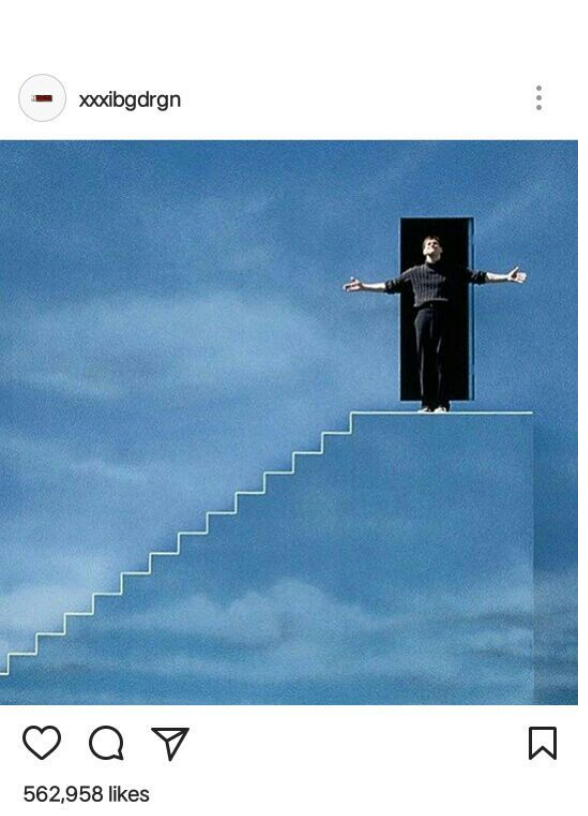
The Truman Show is one of the most innovative yet groundbreaking movies that has transcended the way people think. By introducing the idea of life in a TV Show, The Truman Show has provoked people to decipher the genuineness in life, by exploring philosophical topics and criticizing Reality TV and social media. I would like to redefine The Truman Show as an allegory for the modern artist’s dilemma: authenticity under constant surveillance. Few artists embody this paradox more vividly than G-Dragon, who projects this theme into two of his most recent albums.
Like Truman, G-Dragon lives in a self-constructed world—grand, public, and endlessly observed. His albums mirror the structure of The Truman Show: escapism from his fantasy-like reality, and overcoming the vagueness that used to blur his identity. G-Dragon transforms fame into art and turns his private breakdowns into public breakthroughs, revealing how creation itself becomes the escape and the breakthrough.
Divina Comedia

The title is from Dante’s trilogy, Divina Comedia, where the protagonist goes on an expedition
through the sins and through salvation. The album focuses on the three layers of the world, and GD uses it as a metaphor to reflect on himself, by illustrating his story.
In this particular song, there is a direct correlation to The Truman Show. He criticizes the idol industry and the nature of being a celebrity, as they often overly embellish one’s life and engender ‘fake’ worlds in front of the audience. He also talks about his own state of being constantly monitored, being deprived of his own privacy.
Through the line “Unreal is surreal”, he talks about how the boundaries between reality and imagination have become amorphous. Although he is living his childhood dream as a singer, he has lost himself as Kwon Ji Yong. Therefore, he acknowledges that what was once unreal has
now become surreal, to an extent where he cannot cope with anymore.
The next line pays a direct tribute to the film, by quoting Truman’s most iconic lines with a twist of GD’s identity as a Korean:
“In case I don't see ya, Good-afternoon, Good-evenin' and 굿밤…”
In the film, Truman says this to greet the audience around the world, because wherever they are, they are watching him constantly. GD takes this concept into a more realistic realm, as he relates the lines to signify his lack of own sense of reality and privacy, due to the attention he receives as a celebrity. The “In case I don’t see ya” is used more bluntly in GD’s work, as he used to say that this could be his last comeback.
우리는 각자의 세상에 살고 있어
(We’re living in worlds of our own)
무대에
(On a stage)
기획 제작 각본 연출 주인공 돼
(Planning, producing, scripting, directing, we become the protagonists)
꿈에
(In a dream)
'비현실이 초현실'
'Unreal is surreal'
“In case I don't see ya
Good-afternoon
Good-evenin' and 굿밤...”
— G-Dragon. “OUTRO. 신곡(神곡) (Divina Commedia).” Kwon Ji Yong, 2017
Power

While Divina Comedia reflects GD’s internal struggle with fame, Power shows his outward
evolution and transcendence. This song picks up right where GD has left his scene, for a prolonged period of 7 years. When he first released this song, in a Korean TV show called “You, Quiz?” GD talked about the hiatus of 7 years. He says that:
“In the past, despite my efforts of trying to solve the situation I was in, I couldn’t find a definite answer and felt as if I was cornered into a wall, but now, I have realized that the other side of the wall existed; there was space for me to breathe.”
This interview can be interpreted as a correlation to The Truman Show once again. Truman himself also discovered another world, behind the cardboard walls, after feeling suffocated for so long.
The overall concept of the album revolves around ‘Übermensch’, a concept coined by Friedrich Nietzsche. Übermensch is a person who has evolved into a transcendent form of humanity by overcoming human struggles. GD defines Übermensch as a constantly evolving being, who challenges oneself whether it leads to a bad or a successful outcome, as there is no implicit norm to define the ideal and superior man. He seeks value in the fact that one goes through challenges, and he considers that to be a form of constant transcendence.

However, the most significant correlation between the two songs is discovered through Power’s music video. The whole music video takes place in a rather sketchy set for a K-Pop guru. There are cardboard creations of places and items that relate to GD’s past of living in a set where he
was constantly monitored. In the last part of the music video, GD jumps out from the subway, a place where he was escaping, traveling to a new place—transcending. There is an image of a blue sky where he has landed.
As a fan of his artistic work, his comeback itself feels like ‘Übermensch’ in itself. It is august yet quite emotional to witness the change in a person who wanted to flee from doing his most favorite thing in the world, to see him find his love for music once again and truly enjoy it. I would define GD as an ‘auteur’: being the director of his own film, life, but at the same time, sublimating his film into a greater medium, music.


Comments